
count: [2026-08-25] [Close]
Recently, Dr. HUO Zhipeng and his student ZHANG Jie and CHEN Zuoyang from the Institute of Plasma Physics, Hefei Institutes of Physical Science, Chinese Academy of Sciences (ASIPP) developed a type of flexible PbWO₄-B4C reinforced silicone rubber composite that combines both tritium safety containment and nuclear radiation shielding functions for nuclear fusion facilities. The result was published on Journal of Materials Research and Technology (https://doi.org/10.1016/j.jmrt.2026.07.278).
The tritium safety containment systems for future fusion facilities call for radiation shielding materials that reconcile gas-tight sealing, easy disassembly, and robust shielding against high-flux neutron and gamma radiation, so as to satisfy the simultaneous needs for penetration sealing, maintainability, and radiological safety—thereby rendering the comprehensive performance of such materials a critically demanding priority.
Micron spindle-shaped PbWO₄ (tetragonal dipyramidal crystals) were synthesized by the research team via an aqueous direct precipitation method. A series of silicone rubber composites were then fabricated via hydrosilylation crosslinking casting using the as-synthesized micron-sized spindle-shaped PbWO₄ and micron-sized B₄C as shielding fillers, with comparative evaluations conducted against multiple commercial shielding agents. The spindle-shaped PbWO₄ filler exhibits better polar compatibility with the silicone rubber for better matrix bonding, while its smaller uniform size suppresses matrix chain motion. The PbWO₄/B₄C/silicone composite showed superior thermal stability and mechanical properties: decomposition temperature of 335.4°C, lowest thermal expansion, compressive strength of 5.32 MPa, and moderate tensile strength of 0.92 MPa, meeting the requirements for gas-tightness, and detachability of fusion penetration. Its UV absorption also improved aging resistance with minimal tensile loss after accelerated aging, enhancing environmental service durability.
Monte Carlo simulations and experiments confirmed that the spindle-shaped PbWO₄/B₄C/silicone rubber composite exhibits superior synergistic shielding of neutrons and gamma rays while suppressing secondary gamma rays. At 15 cm thickness, it achieved 93.13% neutron shielding (²⁵²Cf) and 82.76% gamma shielding (¹³⁷Cs), outperforming or matching building concrete.
This work presents a new design strategy for materials used in tritium safety containment and radiation protection in nuclear fusion facilities.

Figure 1. Schematic illustration of the sealing and radiation shielding mechanism of micron spindle-shaped PbWO₄ filler-reinforced flexible silicone rubber for penetration holes in nuclear fusion facilities.
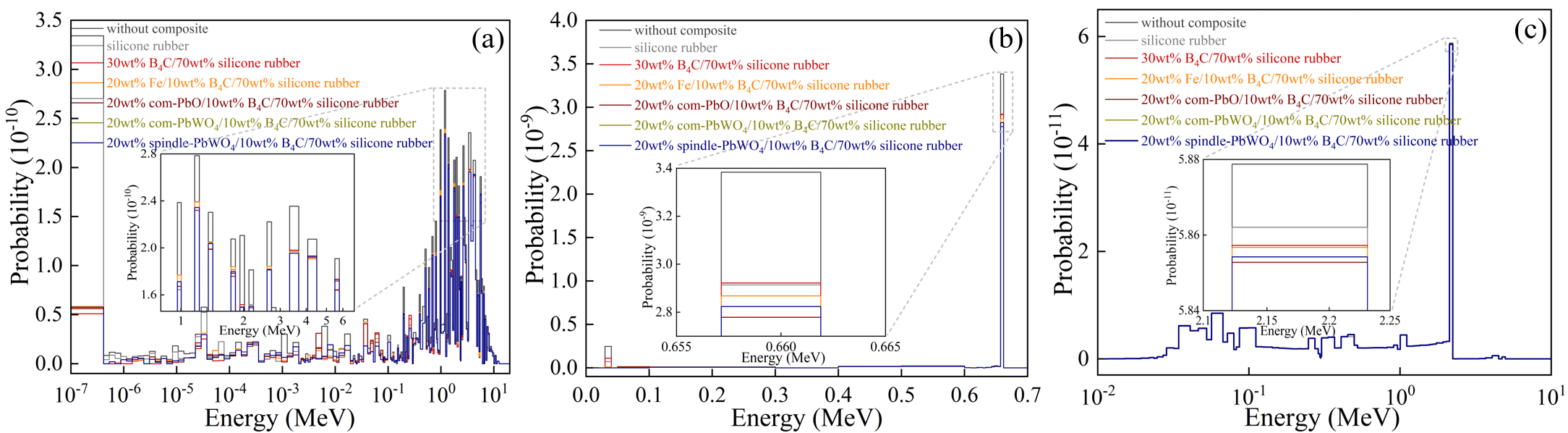
Figure 2. Simulated energy spectra: incident (a) neutrons, (b) gamma rays shielded by various silicone rubber composites, and (c) secondary gamma rays.
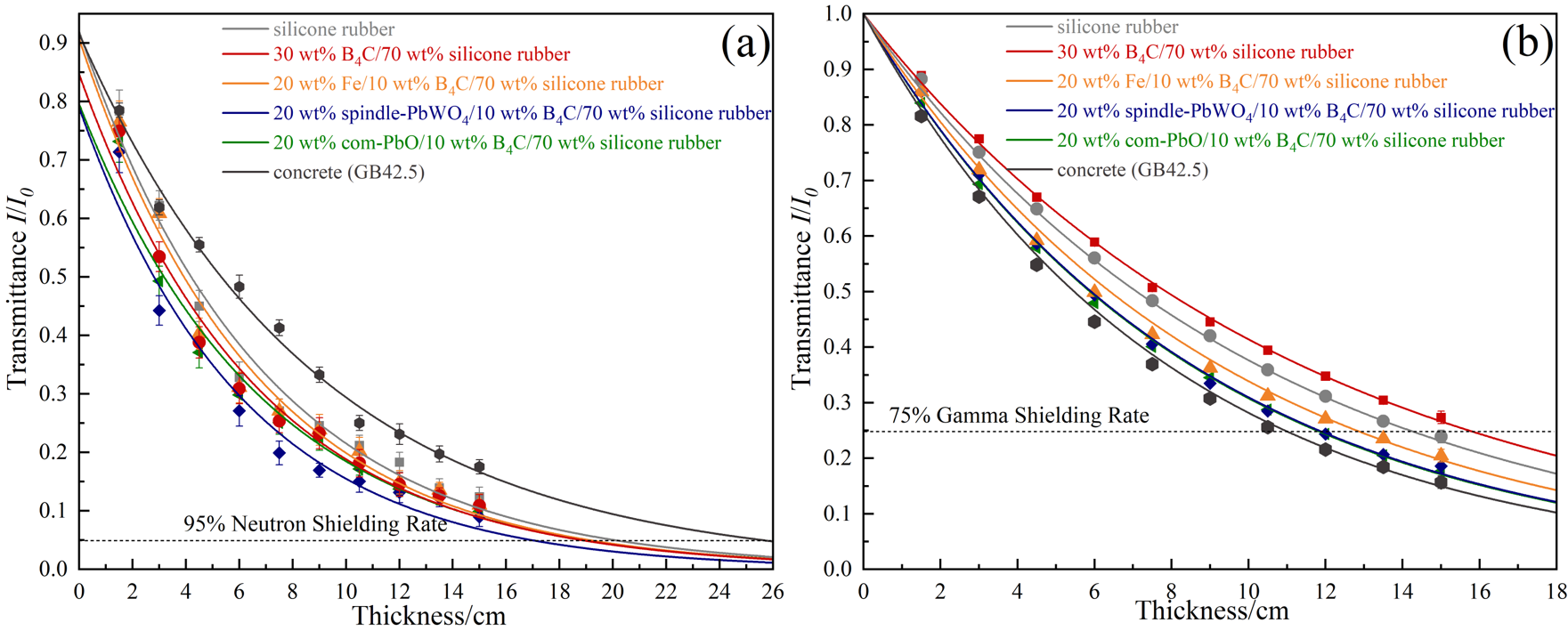
Figure 3. (a) Neutron and (b) gamma ray attenuation curves of different silicone rubber composites and concrete.
© Institute of plasma physics, Chinese Academy of Sciences

Official account


