
count: [2026-07-08] [Close]
Recently, the Institute of Plasma Physics of the Chinese Academy of Sciences, in collaboration with Beijing University of Posts and Telecommunications, Shenzhen University, and China Mobile Software Technology Co., Ltd., has achieved notable progress in diagnostic data analysis on the EAST tokamak using a classical‑quantum hybrid approach. The researchers have developed a physics‑inspired framework that marries Koopman operator theory with quantum machine learning. This design directly tackles two long‑standing obstacles for next‑generation fusion devices: the challenge of cleaning diagnostic signals in real time amid severe electromagnetic interference, and the limited connectivity and qubit resources of noisy intermediate‑scale quantum (NISQ) processors.
Fusion diagnostics generate enormous volumes of multi‑channel time‑series data per discharge, yet a substantial portion is contaminated by noise, sensor glitches, or mechanical disturbances. Conventional threshold‑based methods cannot keep up with evolving plasma regimes, and while classical deep learning delivers high accuracy, it typically requires tens of thousands of trainable parameters—far too heavy for current quantum hardware. Encoding such high‑dimensional, chaotic data into small quantum circuits has thus remained a critical bottleneck.
The team’s key insight lies in a structural isomorphism between Koopman evolution and quantum evolution at the representation level. Building on this, they constructed a two‑stage Koopman‑PQNN pipeline. In the first stage, a Koopman embedding module strips away predictable linear dynamics from raw signals, leaving behind low‑dimensional residual statistics that are highly sensitive to anomalies. These compressed six‑dimensional features are then fed into two parallel three‑qubit quantum circuits. After variational processing, the system outputs a simple normal or anomaly decision, with only about 0.1K parameters updated during training—all confined to the variational layers.
When tested on 4,763 labeled channel sequences from advanced diagnostics on EAST, the Koopman‑PQNN achieved approximately 97.0% anomaly‑detection accuracy on the test set—slightly below the 98.0% of a deep CNN baseline, but with a parameter count merely 0.2% of that of the CNN. More importantly, t‑SNE projections and silhouette scores revealed a clustering quality of 0.800 for the hybrid model, far surpassing the raw‑data CNN (0.392) and the classical feature‑based CNN (0.754).
To probe real‑world feasibility, the researchers simulated finite‑shot/readout errors and Gaussian perturbations to expectation values. The model maintained over 96.2% accuracy even with only 128 measurement shots, and remained above 92.8% under extreme perturbations. The modular architecture—two independent 3‑qubit sub‑circuits—allows each sub‑circuit to run on a separate small quantum processor, easing the reliance on a single large chip and fitting naturally into the NISQ hardware landscape.
Beyond the experimental results, the work rigorously formalizes the Koopman‑quantum isomorphism and provides a scalable theoretical interface for physics‑driven dimensionality reduction combined with quantum processing. The hybrid paradigm—where physics‑based preprocessing feeds compact quantum classifiers—offers a promising practical route for fields dealing with high‑dimensional, dynamically complex, and physically constrained data.
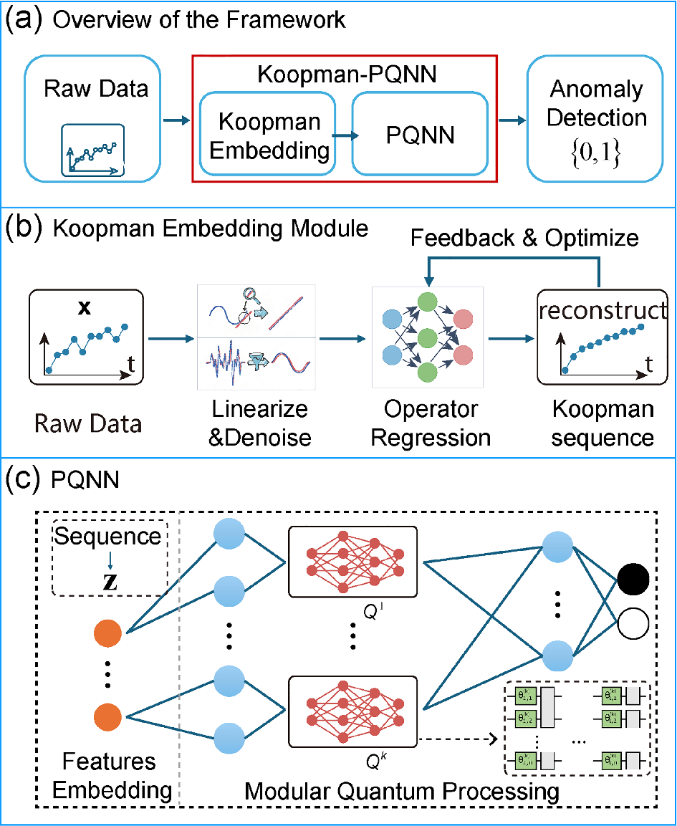
Figure 1. Schematic diagram of the algorithm: (a) Classical-quantum hybrid framework; (b) Koopman embedding module; (c) Parallel quantum neural network (PQNN).
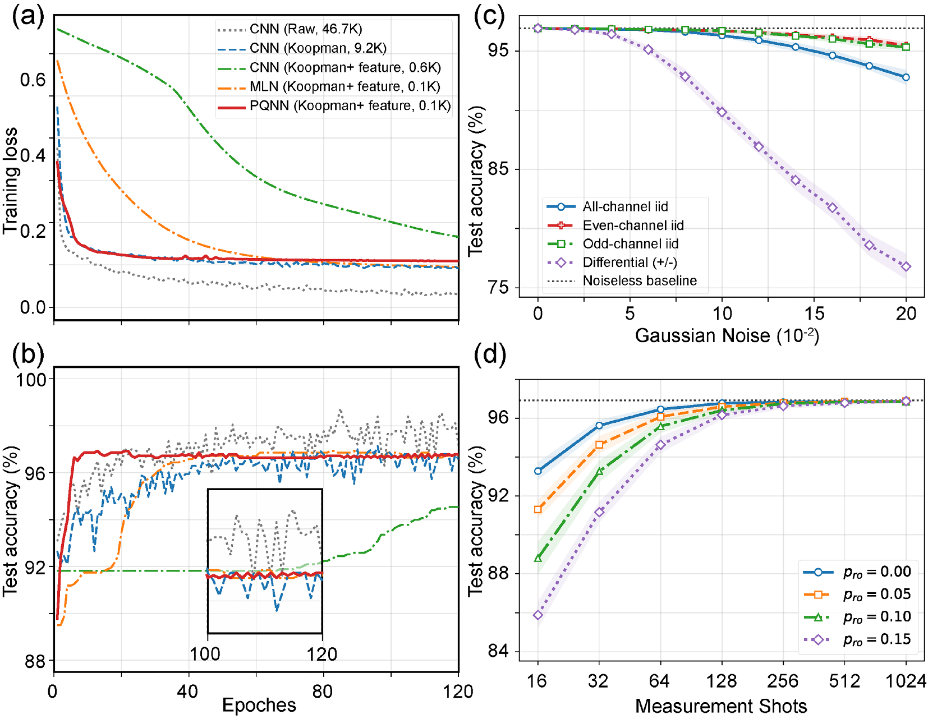
Figure 2. Test results: (a)(b) Comparison of test accuracy and training loss against four baselines; (c) Accuracy variation under expectation value Gaussian perturbation; (d) Accuracy variation under finite sampling/readout errors.
© Institute of plasma physics, Chinese Academy of Sciences

Official account


