
Energy, exergy and environmental analysis of Rankine cycle for a steady state CFETR power plant with divertor as preheater
count: [2026-03-23] [Close]
A research team led by Prof. Guo Bin from the Institute of Plasma Physics, Hefei Institutes of Physical Science, Chinese Academy of Sciences (ASIPP), has developed a novel power conversion strategy that significantly improves the thermal-to-electric efficiency of fusion power plants by utilizing divertor heat as a preheating source in the feedwater system.
The study was published in Energy (doi.org/10.1016/j.energy.2026.140589).
Fusion energy is widely regarded as a promising solution for clean and sustainable power generation. However, efficient thermal-to-electric conversion remains a major challenge for its practical deployment.
In this work, the team proposed an advanced steam Rankine cycle for the steady-state CFETR fusion power plant, introducing a new thermal integration concept. Unlike conventional designs that discard divertor heat as low-grade energy, this study systematically incorporates it into the regenerative feedwater heating process, enabling effective use of previously underutilized low-temperature heat.
The optimized system achieves a thermal efficiency of 35.36%, about 3% higher than traditional blanket-based Rankine cycles. Results show that combining divertor heat recovery with a reheat stage significantly improves performance. The optimal steam inlet temperature and turbine isentropic efficiency were identified as 490 °C and 92%, yielding a turbine exergy efficiency of 87.23%.
Benchmark comparisons with DEMO-scale fusion plants show good agreement, with deviations of around 2%, confirming the reliability of the design.
By enhancing heat utilization and reducing energy losses, this strategy provides an effective way to integrate multiple heat sources in fusion systems, offering a practical pathway toward more efficient and economically viable fusion power.
“Efficient thermal-to-electric conversion is one of the key challenges in realizing commercial fusion energy,” said the researchers. “Our approach provides a feasible solution for achieving high-efficiency, steady-state operation.”
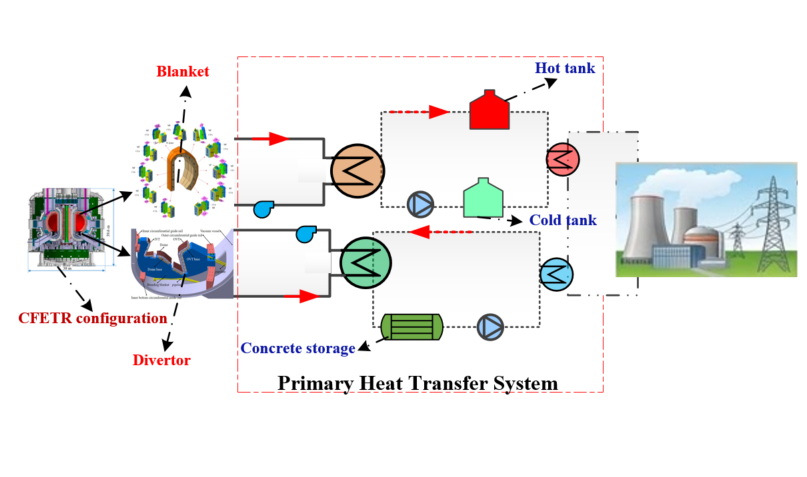
CFETR configuration and heat transfer system.
© Institute of plasma physics, Chinese Academy of Sciences

Official account


