
Researchers from the Institute of Plasma Physics, Hefei Institutes of Physical Science, Chinese Academy of Sciences (ASIPP), led by Professor Guosheng Xu and collaborators, have reported a new advance in the integrated control of transient and steady-state heat loads on divertor targets. Their work demonstrates, for the first time in a metal-wall environment, a plasma regime that simultaneously combines partial divertor detachment, an edge-localized-mode (ELM)-free high-confinement mode (H-mode), and high pedestal performance. This integrated regime was sustained for a duration on the order of minutes. The results provide a new potential solution to the critical challenge of reconciling divertor heat load management with high-performance plasma confinement in future fusion reactors. The findings have been published in the journal Physical Review Letters (https://doi.org/10.1103/7r3f-dqft).
Achieving controllable nuclear fusion is a pivotal direction in the quest for sustainable and clean energy. In next-step fusion devices like ITER, managing divertor heat loads presents a severe challenge. The divertor target plates must withstand extremely high steady-state heat flux, which is typically mitigated by seeding light impurity gases to induce a detached divertor state. Furthermore, in H-mode, a periodic instability known as the edge-localized mode (ELM) occurs at the plasma boundary. The transient heat loads from ELM bursts can damage internal components and introduce impurities. However, deep detachment often cools the plasma edge, or pedestal region, leading to performance degradation. Previously achieved ELM-free operations have also frequently been accompanied by a deterioration in pedestal performance. Therefore, developing a steady-state operational regime that concurrently achieves divertor detachment, ELM suppression, and a high-performance pedestal has been a major international research goal.
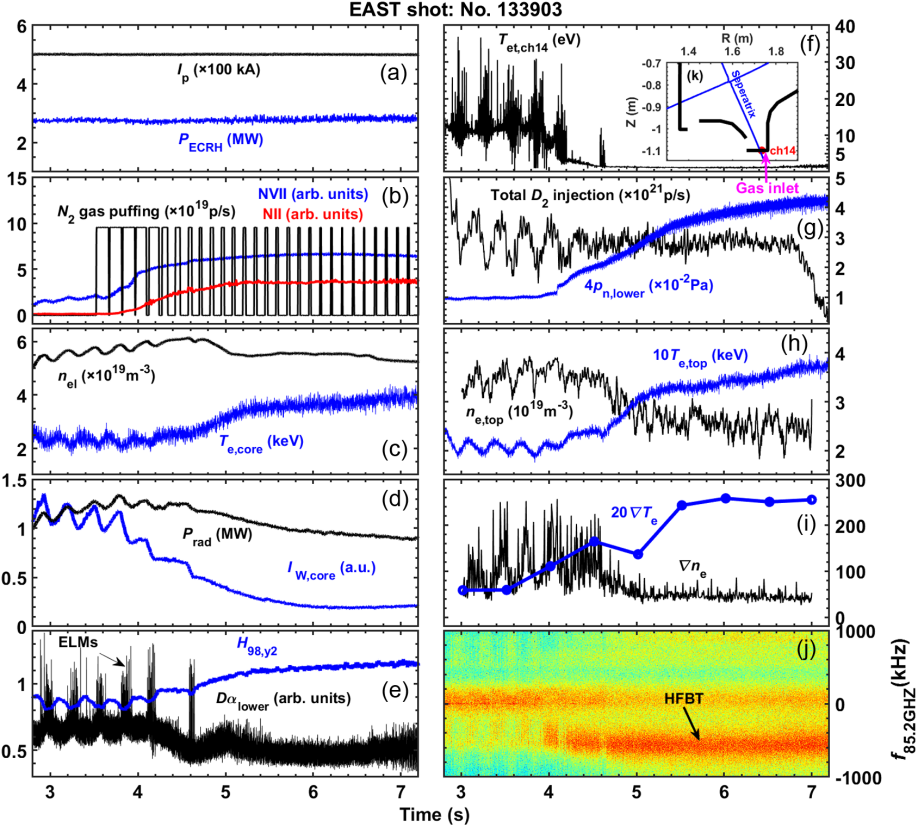
Figure 1. Achievement of partial divertor detachment, ELM suppression, and marked improvement in pedestal performance via light impurity injection.
In this work, the research team utilized feedback-controlled seeding of a light impurity gas to establish a regime termed the Detached divertor and Turbulence-dominated Pedestal (DTP) regime on the Experimental Advanced Superconducting Tokamak (EAST). In discharges dominated by this mechanism, the heat flux on the divertor target plates was significantly reduced, ELMs were completely suppressed, and the electron temperature at the pedestal increased markedly, leading to an overall improvement in global plasma energy confinement. The study found that the state of partial detachment, combined with a closed divertor geometry, helped to trap and pump neutral particles within the divertor region. This reduced the cooling of the pedestal by recycling neutrals and seeded impurities, thereby increasing the pedestal temperature gradient. The enhanced gradient provided sufficient free energy to drive micro-instabilities, exciting a high-frequency broadband turbulence. Large-scale gyrokinetic simulations identified this turbulence as a temperature-gradient-driven trapped electron mode. This turbulence drives sustained outward transport of particles and heat in the pedestal region, forming a natural transport channel. This channel limits pedestal growth, suppresses the triggering of ELMs, and maintains steady-state ELM-free operation. Based on this research, the team achieved and sustained minute-scale DTP discharge operation.
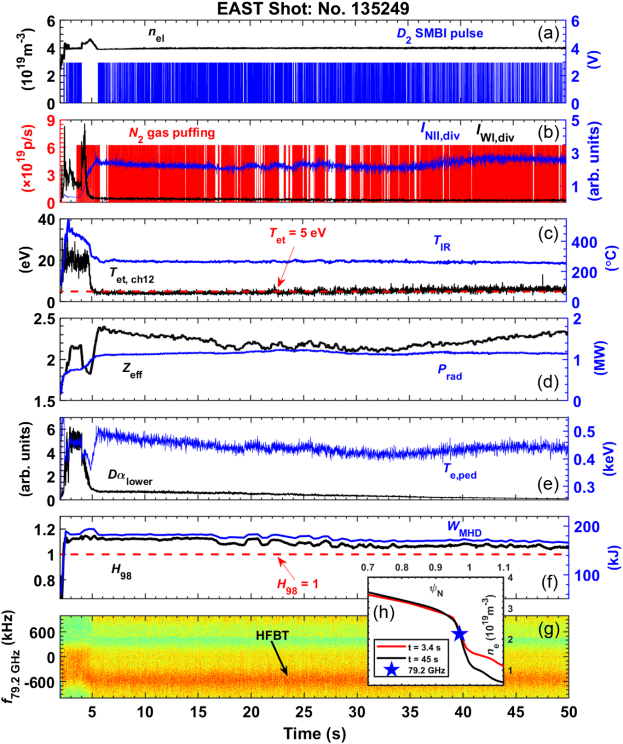
Figure 2. Achievement of high-performance long-pulse operation compatible with ELM-free state and divertor detachment via light impurity injection.
The significance of this research lies not only in demonstrating a high-performance integrated operational mode but, more importantly, in clarifying the underlying physical mechanism. The key physics of the DTP regime is that partial divertor detachment combined with a closed divertor configuration increases the pedestal temperature gradient, which in turn excites the temperature-gradient-driven trapped electron mode turbulence. This turbulence establishes a stable, outward channel for particle and heat transport across the pedestal, thereby limiting pedestal pressure growth while maintaining high performance and suppressing ELMs. This physical process is governed by parameters such as temperature gradient, density gradient, and collisionality, rather than being dependent on specific impurity species or absolute device parameters. Analysis indicates that the ITER pedestal is projected to have a lower density gradient, weaker E×B flow shear, and lower collisionality. These conditions are expected to be more favorable for exciting the trapped electron mode turbulence central to the DTP regime. Consequently, the DTP operational mode is considered a promising candidate scenario for achieving long-pulse, high-performance operation in ITER and future fusion reactors.
© Institute of plasma physics, Chinese Academy of Sciences

Official account


